

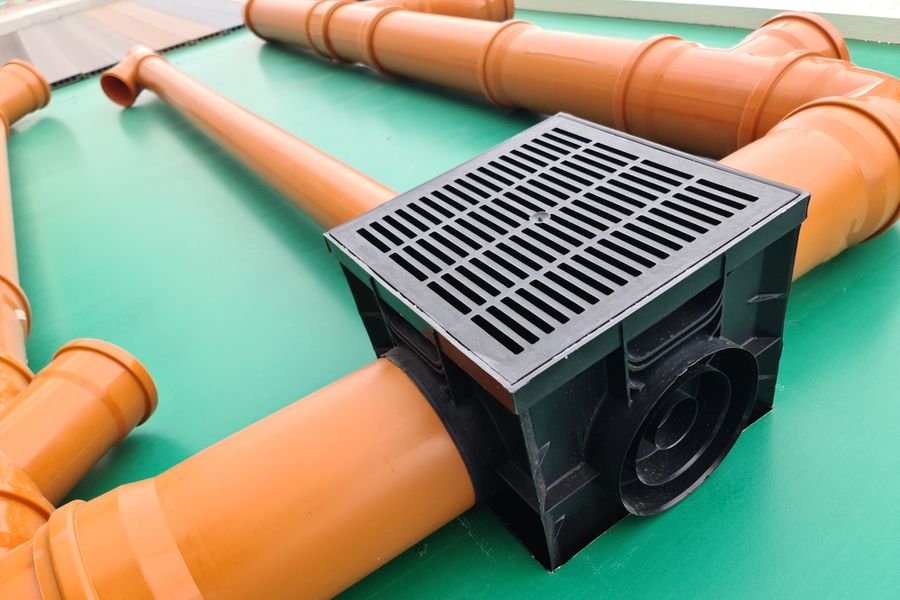
Water collecting beside a foundation is more than a temporary nuisance. Repeated saturation can contribute to basement dampness, water entry, and deterioration in building materials. A French drain kit provides a packaged method for intercepting water moving through soil and directing it toward a lower discharge point. The system can be effective, especially when the original moisture source, trench route, pipe slope, filtration, and outlet are considered together rather than treated as separate decisions.
Know What the Kit Contains
A conventional French drain combines perforated pipe with clean drainage stone and filter fabric. Gravel-free kits package these functions differently. For example, the EZ-Drain uses slotted pipe surrounded by recycled polystyrene aggregate and enclosed in geotextile mesh, forming a preassembled bundle for foundation and other subsurface drainage applications.
A kit may not include every item needed for the job. Couplers, adapters, solid discharge pipe, an outlet fitting, tools, and extra fabric may be separate purchases. Check the specifications for pipe diameter, bundle length, applications, connection methods, burial instructions, and soil limits before planning the trench.
French drain kits are available from major home-improvement retailers, including Home Depot and Lowe's.
Identify the Water Source
A French drain should address water moving through saturated ground, not hide a different defect. Basement moisture can result from soil sloping toward the house, settled backfill, defective gutters, short downspouts, cracks, groundwater, plumbing leaks, or indoor humidity. Controlling the source is generally more effective than trying to stop moisture only after it reaches the structure.
Observe the property during and after rain. Note where roof runoff lands, which slopes direct water toward the house, where puddles remain, and where indoor dampness appears. If gutter discharge is the main issue, downspout extensions or grading may deserve attention before excavation. A French drain is a stronger fit when subsurface water approaches from an uphill or persistently saturated area.
Establish a Downhill Route
Collected water needs a defined destination. Foundation-drain guidance describes perforated pipe installed with a slight slope toward a collection point, where it connects to nonperforated pipe. That solid pipe can discharge to daylight at a lower location or lead to an alternative such as a dry well, storm sewer, or sump system.
Plan the outlet before marking the trench. Avoid sending water back toward the house, across a walkway, or into another low area. Municipal approval may be required before connecting foundation drainage to a storm sewer. The best path maintains steady fall and ends at an accessible outlet.
Prepare and Dig Safely
Contact 811 before excavation. The national service advises making the request at least two to three business days before digging, providing details about the work area, and waiting for utilities to mark the approximate locations of underground lines.
Utility markings may not include privately installed irrigation tubing, lighting cables, invisible-fence wires, or septic components. Identify those features separately, along with roots, patios, steps, retaining walls, and soil supporting the foundation. Deep excavation beside footings or structural elements can move the project beyond a basic do-it-yourself installation.
Install the Drainage Layers Correctly
For a traditional system, clean washed gravel helps water reach the perforated pipe, while filter fabric limits silt and sand entering the drainage layer. Foundation-drain guidance calls for secure connections, solid pipe along the discharge run, and filter fabric wrapped around the gravel and drain tile.
Follow the kit instructions because trench dimensions and pipe orientation can differ. Maintain the required slope, support the pipe evenly, and avoid low spots. Before backfilling, inspect every coupling and confirm that the outlet is lower than the collection area. Preserve surface grading so ordinary runoff continues moving away from the building.
Surface drainage and subsurface drainage should work together. If the finished soil still slopes toward the foundation, rainfall will continue concentrating near the wall even after the pipe is buried. Correcting settled soil, maintaining gutters, and extending downspouts can reduce the amount of water the French drain must manage.
Inspect the Outlet
The outlet provides the clearest evidence that the system is working. Drainage maintenance guidance recommends inspecting components before and after significant rain, clearing debris from openings, checking connected pipes, and keeping pop-up emitters free of turf and blockages. A clogged emitter can back water up through the drainage system.
After storms, look for discharge and reduced ponding near the foundation. Settlement over the trench, renewed dampness, erosion, or water appearing elsewhere may indicate a blockage, poor slope, a loose connection, or inadequate capacity. Keep outlets and cleanouts accessible rather than covering them with soil, mulch, or dense planting.
Make the Kit Part of a Complete Plan
A French drain kit can reduce material handling and simplify component selection, particularly when pipe, aggregate, and filtration arrive as one bundle. It cannot compensate for an incorrect diagnosis, a flat trench, or an outlet that sits too high. Effective drainage begins with observing how water moves, correcting obvious roof and grading problems, and selecting a route that carries subsurface moisture to a dependable release point.
Professional evaluation is appropriate when the work requires deep excavation beside a foundation, passes near structural supports, or addresses continuing indoor water entry. On a manageable site with a clear downhill path, a properly selected and installed kit can become one practical layer in a broader strategy for protecting the foundation.