

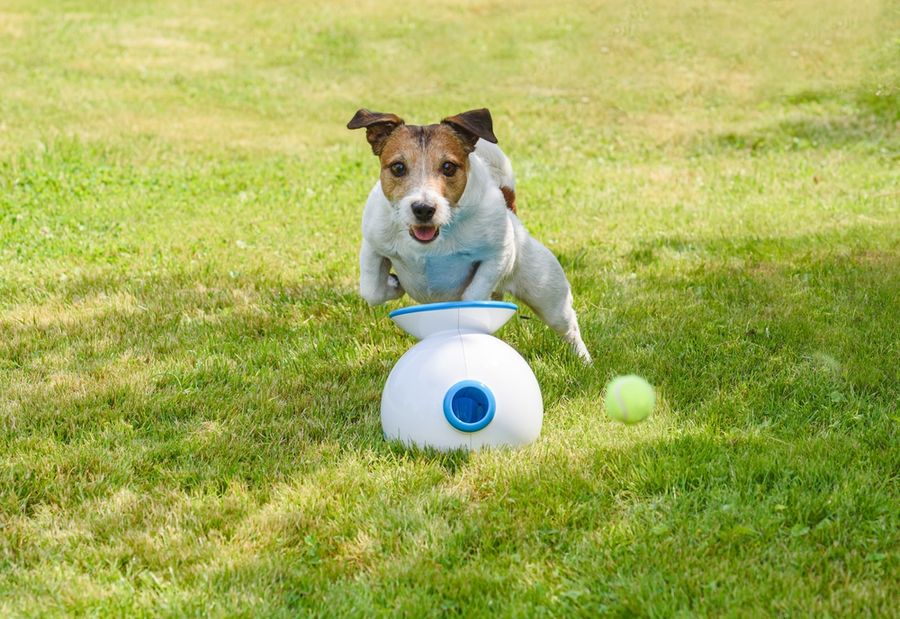
A high-energy dog can turn fetch into an endurance test for the person holding the ball. Automatic launchers extend play by sending balls at repeatable distances while allowing the owner to focus on training, supervision, and rest breaks. The best model depends on the dog’s size, preferred ball, available space, and tolerance for noise. Fortunately, the top launchers offer different combinations of range, portability, safety controls, and loading design.
PetSafe Automatic Ball Launcher Emphasizes Adjustable Play
The PetSafe Automatic Ball Launcher provides nine distance settings and six angle settings, sending standard-size tennis balls from approximately 8 to 30 feet. It holds up to three balls, includes two, and can run from the included power adapter or six D-cell batteries. Its water-resistant housing is intended for indoor and outdoor use.
Motion sensors prevent a launch when a dog or person is detected within seven feet of the opening, and an audible tone sounds before the ball fires. After 30 minutes of play, the unit enters a 15-minute rest period. This combination suits households that want more control over session length and launch direction.
iFetch Too Reaches Across Larger Yards
The iFetch Too launches standard tennis balls at 10, 25, or 40 feet and includes a random-distance setting. It comes with three 2.5-inch balls, a built-in rechargeable battery, a charging plug, and a carrying handle. It is designed for medium and large dogs, and owner supervision is recommended.
Its longest setting gives strong runners more room in an open yard, while the shorter settings accommodate tighter spaces. The random mode changes the distance from one throw to the next without repeated adjustment. Indoor use still requires a clear launch path and enough room for the dog to turn and return safely.
iDogmate Big Offers a Wide Loading Hopper
The iDogmate Big uses 2.5-inch felted balls and provides several speed options plus a variable setting. Its 9.5-by-9.5-inch hopper creates a broad target for dogs learning to return the ball. The launcher works from an included AC adapter or rechargeable lithium-ion batteries, with up to 250 launches listed for a full charge.
The large hopper is the model’s most distinctive feature. A dog does not need to place the ball through a narrow opening, which may simplify return training. The machine supports indoor and outdoor use, but it should still face a clear route with the dog approaching from the side.
Franklin Ready Set Fetch Handles Wet Balls
The full-size Franklin Ready Set Fetch works with standard tennis balls and includes one nonabrasive tennis ball plus a specially designed all-weather launcher ball. Adjustable feet provide three launch-angle positions, while a motor dial changes distance. The all-weather ball can travel more than 50 feet even when wet or slobbery.
The launcher also includes a power adapter, carry handle, battery compartment for eight D batteries, and an optional warning sound before launch. This model suits outdoor sessions where damp grass and saliva may affect ordinary tennis balls. Its potential range requires a large, secure area without roads, people, or fragile objects in the flight path.
Match the Launcher to the Space
Ball size should be the first filter. These four models use standard or approximately standard-size balls, making them better suited to dogs that can comfortably carry that format. Owners of smaller dogs should look for a launcher specifically designed around miniature balls rather than substituting an unsupported size.
Next, compare maximum distance with the actual play area. A 40- or 50-foot setting adds little value in a short or crowded yard. Shorter distances and adjustable angles may work better around landscaping or indoors. Power matters too: plug-in operation suits a fixed location, while batteries or a rechargeable pack make the launcher easier to move.
Train for Safe, Supervised Fetch
Introduce the launcher while it is switched off, allowing the dog to investigate without a sudden motor sound. Add treats and familiar cues, then introduce the tones and launch noise from a comfortable distance. If the dog appears stressed, pause rather than forcing the interaction.
Teach the dog to stand beside the launcher, not in front of it, and practice dropping the ball on command before expecting self-loading. Supervision remains necessary after the dog understands the routine. Inspect the ball before each session, keep the launch route clear, and use the machine only where every throw can land safely.
Choose Repeatable Fun, Not Endless Exercise
PetSafe provides the broadest combination of distance, angle, sensing, and automatic rest controls. The iFetch Too offers a 40-foot maximum with rechargeable portability. The iDogmate Big centers on a generous hopper and variable launching, while Franklin’s Ready Set Fetch adds an all-weather ball and long outdoor range.
The right launcher should fit the dog, ball, and space before it fits a feature checklist. Automatic fetch can add useful repetition, but it should remain supervised and include training and breaks. A well-matched machine gives an energetic dog another outlet without turning every session into an uncontrolled marathon.