

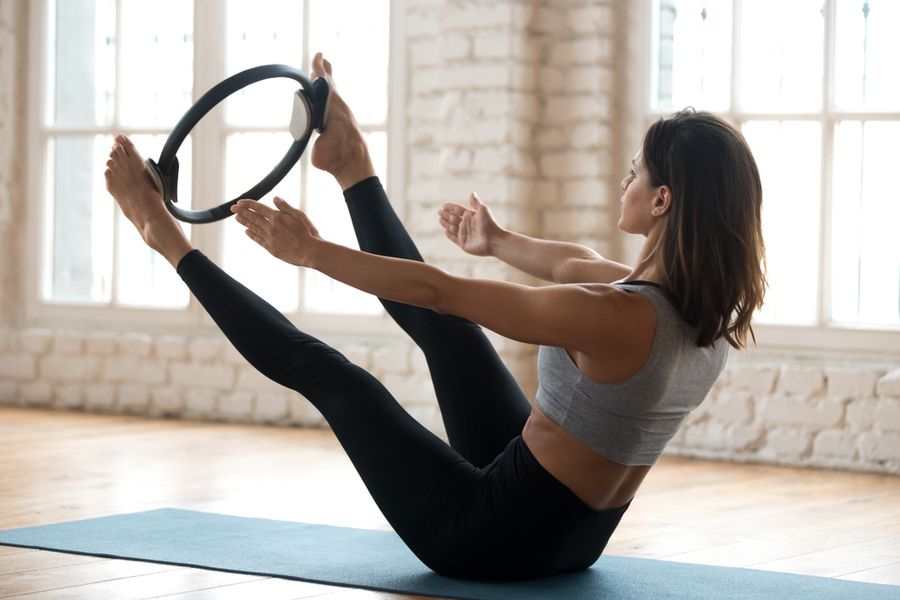
A Pilates ring can make familiar mat exercises feel newly demanding without adding a bulky machine or heavy weights. The flexible circle creates spring resistance when pressed between the hands, thighs, knees, or ankles, and it can also provide an external cue for alignment. Used thoughtfully, it adds challenge to bridges, abdominal work, side-lying leg exercises, and upper-body movements while keeping the workout compact enough for a living room floor.
How the Ring Changes Mat Work
A Pilates ring, sometimes called a fitness circle or magic circle, resists compression and returns toward its original shape. It's a tool for adding resistance to the arms and legs, challenging the core, and supporting rotational, abduction, and adduction movements.
The spring action lets users build pressure gradually instead of holding a fixed weight. It also creates tactile feedback: if the ring shifts, tilts, or loses contact, the knees, arms, or shoulders may no longer be moving evenly. The goal is controlled pressure, not crushing the ring as far as possible.
Build Resistance Into Lower-Body Moves
The shoulder bridge is one of the clearest ways to feel the ring’s effect. Users should place the circle between the legs above or below the knees, avoiding the knee joint, and squeeze it several times while holding the bridge. Its guidance also emphasizes preventing the ribs from lifting excessively and maintaining a natural spinal curve while lowering.
The same idea can be applied to bent-knee abdominal work and other supine exercises. A light inward press asks the inner thighs to remain active while the trunk moves. Pressure should stay steady without twisting the pelvis or changing the intended leg path.
Add Upper-Body Effort
Holding the ring between the palms creates resistance for seated, kneeling, or lying exercises. Ring-based programming often includes chest presses and overhead movements, showing that the prop is not limited to inner-thigh work.
Keep the wrists aligned with the forearms and the shoulders away from the ears. A small, controlled pulse often works better than a hard squeeze that changes posture. The ring can also be held with minimal compression to keep the hands evenly spaced during a roll-up, rotation, or overhead reach.
Use the Ring as an Alignment Cue
Resistance is only part of the ring’s value. Placing it between the legs can make changes in spacing easier to notice, while holding it between the hands can reveal uneven pressure. It's recommended to position the Fitness Circle between the hands, legs, or ankles to challenge core engagement, activate the inner thighs, and refine upper-body alignment.
During a bridge, equal contact on both pads can encourage the knees to remain centered. During arm work, the ring may make it easier to notice whether one shoulder is pushing forward. It does not correct alignment automatically, but it provides a physical reference point that bodyweight-only exercises may not offer.
Choose a Ring That Fits
Pilates rings vary in diameter, material, grip design, and resistance. Merrithew’s 14-inch Fitness Circle Lite weighs 0.75 pounds and has foam grips on the inside and outside. It's a lightweight option suitable for beginners, home users, and travel.
Balanced Body’s standard Ultra-Fit Circle measures 15 inches and provides resistance approximately equivalent to its three-band spring circle. Its 12-inch Ultra-Fit Circle Mini has lighter resistance and is intended for beginning practitioners, leg-alignment work, and upper- or lower-body exercises. A suitable ring should sit comfortably against the body without pressing into a joint.
Progress Without Sacrificing Control
Begin by adding the ring to one or two familiar exercises rather than rebuilding the entire workout around it. Use gentle compressions, pause briefly under tension, and release slowly. If the neck tightens, breathing becomes forced, or the spine changes position, reduce the pressure or return to the exercise without the ring.
More resistance is not automatically better. A bridge should remain a controlled hip lift, and an abdominal curl should still come from the trunk rather than an aggressive arm squeeze. Anyone managing pain, recovering from injury, or uncertain about positioning should seek guidance from a qualified Pilates instructor or appropriate health professional.
A Small Prop With a Noticeable Effect
A Pilates ring brings resistance to floor workouts without requiring a large footprint or complicated setup. It can intensify lower-body exercises, add upper-body effort, and provide feedback about spacing and symmetry. Its usefulness depends on precise placement and controlled pressure.
The strongest approach is to choose a suitable size, start with familiar movements, and treat alignment as more important than maximum compression. Used that way, the ring does not replace mat Pilates. It makes the existing work more deliberate by adding another layer of resistance and attention.